Let me be straight with you. West Hills and Canoga Park share a border. They share a zip code overlap. They share a freeway. On a map, they look like the same neighborhood. On the ground, they are not.
The decision between them is one of the more common ones I get asked about in the West Valley. Buyers come in wanting West Hills because they heard it was the nicer option, then balk at the price. Or they come in priced for Canoga Park, then get scared off by the old Canoga Park reputation that's been outdated for a decade. Both of those starting points miss the real picture.
This is the honest side-by-side. Price, housing stock, schools, commute, and how each neighborhood actually fits in 2026. If you're trying to figure out which side of the line makes sense for you, this is the framework.
The Geography Matters More Than You Think
West Hills sits in the far west end of the San Fernando Valley, tucked up against the Santa Monica Mountains and the Simi Valley line. Canoga Park sits just to the east, closer to the center of the west Valley, bordered by Woodland Hills to the south and Winnetka to the east.
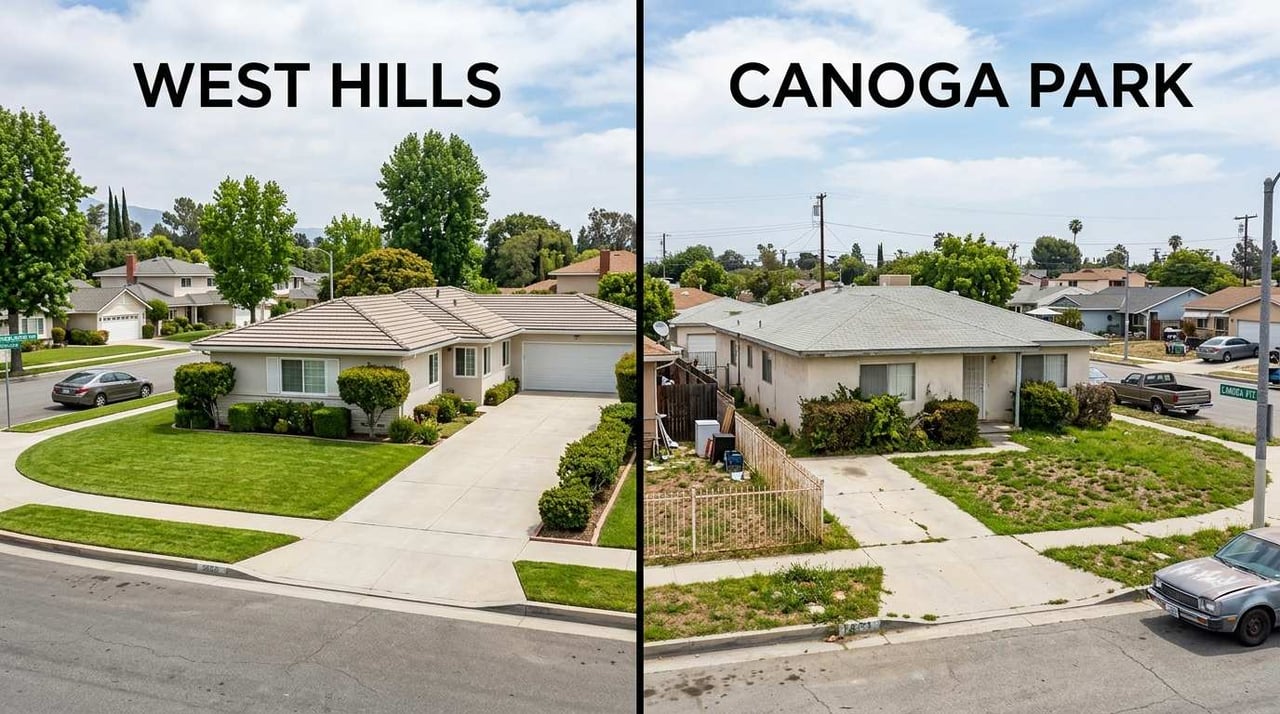
The two neighborhoods share a physical border along De Soto Avenue and Sherman Way. That border is where the price delta really shows up. Drive a few blocks west, and the homes get bigger, newer, and more expensive. Drive a few blocks east, and the homes get smaller, older, and more affordable.
Most buyers don't realize how much of the West Hills price premium is just geography. You're paying for mountain proximity, for newer tract development, and for the West Hills name. You're not paying for a fundamentally different location in the Valley.
The Price Gap Is Real, and It Tells You a Lot
Let me put actual numbers on this.
In early 2026, median home prices in West Hills hover around $1.1M to $1.3M, depending on the pocket. You're looking at 3- and 4-bedroom single-family homes on larger lots, many built from the 1970s through the 2000s, with some newer pockets north of Roscoe Boulevard.
Canoga Park median prices sit around $750K to $900K. You're looking at smaller lots overall, older housing stock from the 1950s and 1960s, plus a meaningful mix of condos and townhomes that pull the median down.
That's a gap of roughly $300K to $400K for properties that are, in many cases, a five-minute drive from each other. What you're paying for in that gap breaks down into a few specific things: newer construction, larger lot sizes, the West Hills school perception, and the neighborhood's more polished feel.
The question you have to answer honestly is whether that gap is worth it for your specific situation.
What You're Actually Buying in West Hills
West Hills housing stock leans newer and more uniform. You get a lot of tract development from the 70s, 80s, and 90s, plus a meaningful pocket of newer construction in the north end. Lots are typically 7,000 to 10,000 square feet. Homes run 2,000 to 3,500 square feet on average.
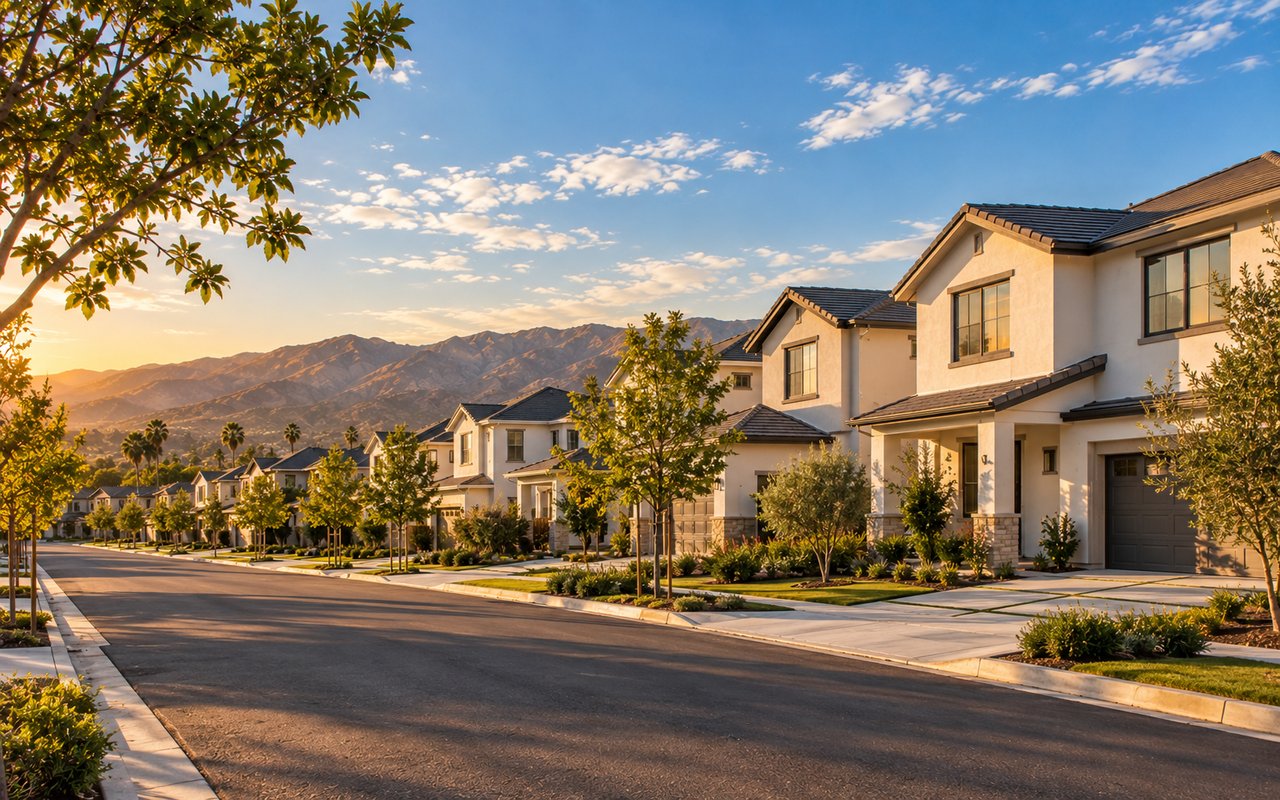
The feel is polished suburban. HOAs are more common, especially in the newer pockets. Yards are manicured. Streets are wider. It feels closer to what people picture when they think "nice California suburb."
You get genuine access to hiking and open space. Upper Las Virgenes Canyon and the Santa Monica Mountains start right at the western edge. If outdoor access matters to you, this is a real amenity.
The downside of West Hills housing stock: a lot of it is already built out to its potential. ADU math is less compelling on a newer tract home with an HOA than on an older ranch with a long driveway and a detached garage.
What You're Actually Buying in Canoga Park
Canoga Park is more of a real neighborhood in the older sense. Mid-century ranch homes from the 50s and 60s dominate. Lots are often smaller, typically 5,500 to 7,500 square feet, but a surprising number of the older ranch lots are deeper than they look. Homes run 1,200 to 2,000 square feet on average.
The feel is working-class California Valley. Less HOA. More diversity. Real community. Some pockets are more polished than others. The Warner Ranch area and the streets closer to Woodland Hills tend to show better. The pockets closer to Sherman Way vary block by block.
The upside of Canoga Park housing stock is significant: ADU potential is one of the strongest in the Valley. Older ranch lots with detached garages and long driveways convert well. You can buy a 1,500-square-foot ranch for under $850K, add an ADU, and either generate rental income or have a guest house on a lot that still totals under $1M all-in. That math doesn't work in most of West Hills.
Canoga Park is also where a lot of the Valley's rental investor activity is happening right now. That creates both opportunity (value) and risk (tenant-occupied listings, absentee landlords, and maintenance neglect on some properties). You have to look carefully.
Schools: The Honest Comparison
This is where a lot of West Hills vs. Canoga Park decisions actually get made, so let me be direct.
West Hills is served by a mix of LAUSD schools with generally stronger ratings. El Camino Real Charter High School is a genuine draw, and some of the elementary schools in the West Hills area are considered stronger than the Valley average.
Canoga Park is served by LAUSD schools that vary more widely in rating. Some elementary schools serving Canoga Park are solid. Others are weaker. Canoga Park High School has a mixed reputation, though it has improved in recent years and offers specific academy programs worth understanding.
Here is what most buyers miss: school attendance zones do not follow neighborhood boundaries cleanly. A home "in Canoga Park" might feed into El Camino Real. A home "in West Hills" might feed into a different high school entirely. Before you use schools as the tiebreaker, pull the actual attendance zone for the specific address you're considering. Not the neighborhood. The address.
The Commute Question
Both neighborhoods face the same West Valley commute reality. If you work anywhere east of the 405 or on the Westside, you're looking at a meaningful drive. Both sit off the 101, with Canoga Park slightly more central to 101 access and West Hills slightly closer to the 118.
For people working in Warner Center, both neighborhoods are excellent. Warner Center is minutes from either one, and the commute works.
For Westside, downtown, or Burbank commuters, both are tough. The specific minute difference between West Hills and Canoga Park is not going to be the deciding factor. What will matter more is whether your employer supports hybrid or remote work, because that's what makes West Valley geography workable in 2026.
What's Changing in Each Neighborhood
West Hills is relatively stable. It's not a neighborhood in transition. Prices have appreciated steadily, but there's no dramatic shift happening. You're buying a known quantity.
Canoga Park is the more dynamic story. Warner Center expansion is pushing development pressure west into Canoga Park. ADU activity is meaningful. New mixed-use projects along Sherman Way and Owensmouth are slowly reshaping the commercial corridors. The neighborhood is gentrifying in some pockets, still rough in others.
If you're an investor or a buyer with a 7-plus year horizon, Canoga Park's trajectory matters. You're not just buying the neighborhood as it is. You're buying what it's becoming.
Who West Hills Is For
- Families prioritizing school perception and polished surroundings. You get newer construction, wider streets, and a more uniform feel. If that matters to you, it's worth the premium.
- Buyers who want the outdoor access. Mountain proximity is real. If hiking, open space, and the feeling of being at the edge of the Valley matter, West Hills delivers.
- Move-up buyers from central Valley neighborhoods. If you're selling a Van Nuys or Reseda home and looking for more square footage and newer construction, West Hills is a natural step up.
- Buyers who simply prefer a quieter, more residential feel. Less commercial bleed. Less variation block to block. You get consistency.
Who Canoga Park Is For
- Value-first buyers. You get more square footage per dollar, more lot per dollar, and more ADU potential per dollar than almost anywhere in the West Valley.
- Investors. Rental math works. ADU math works. Mid-term holds and long-term holds both make sense.
- First-time buyers are priced out of Woodland Hills or West Hills. You get into homeownership in a west Valley neighborhood with real upside instead of stretching for a smaller property in a more expensive name.
- Buyers are comfortable with block-to-block variation. If you're willing to do the work of finding the right pocket, Canoga Park rewards you. If you need every block to feel the same, this isn't the neighborhood.
- Creative types and real-community seekers. Canoga Park has more character, more diversity, more texture than West Hills. That's a plus for some buyers. Not for everyone.
The Honest Downsides of Each
Neither neighborhood is perfect. Let me be direct about what you're trading off.
West Hills downsides. You pay a premium for the name and the perception. The ADU math is weaker. Some pockets feel sterile. The neighborhood appreciation is steady but not dynamic. HOAs can add meaningful monthly carrying costs.
Canoga Park downsides. Block-to-block variation is real, and some blocks are rougher than others. Tenant-occupied listings and absentee landlords complicate parts of the inventory. School zones vary widely. The neighborhood's reputation lags behind its reality, which means your home's eventual resale narrative is a factor to consider.
The Bottom Line
West Hills and Canoga Park are not interchangeable. They're two different decisions that happen to share a border.
If your priorities are polished, uniform, school-perception-driven, and you have the budget, West Hills is the cleaner choice. You pay more. You get a more predictable outcome.
If your priorities are value, ADU potential, investor math, or getting into the West Valley without stretching, Canoga Park is the smarter play. It requires more front-end work to find the right pocket. The upside is better.
Neither answer is right for everyone. The right answer depends on your specific situation, budget, timeline, and what you actually need out of a neighborhood. If you want to talk it through with someone who sells in both and has no stake in pushing you one way or the other, the contact info is below.
Justin Bonney | Clear Way Real Estate
DRE #01338897
Justin Bonney is a California real estate agent (DRE #01338897) and the owner of Clear Way Real Estate in Sherman Oaks. He specializes in Lake Balboa, Van Nuys, Sherman Oaks, and the surrounding San Fernando Valley.