Rail is coming back to Van Nuys Boulevard
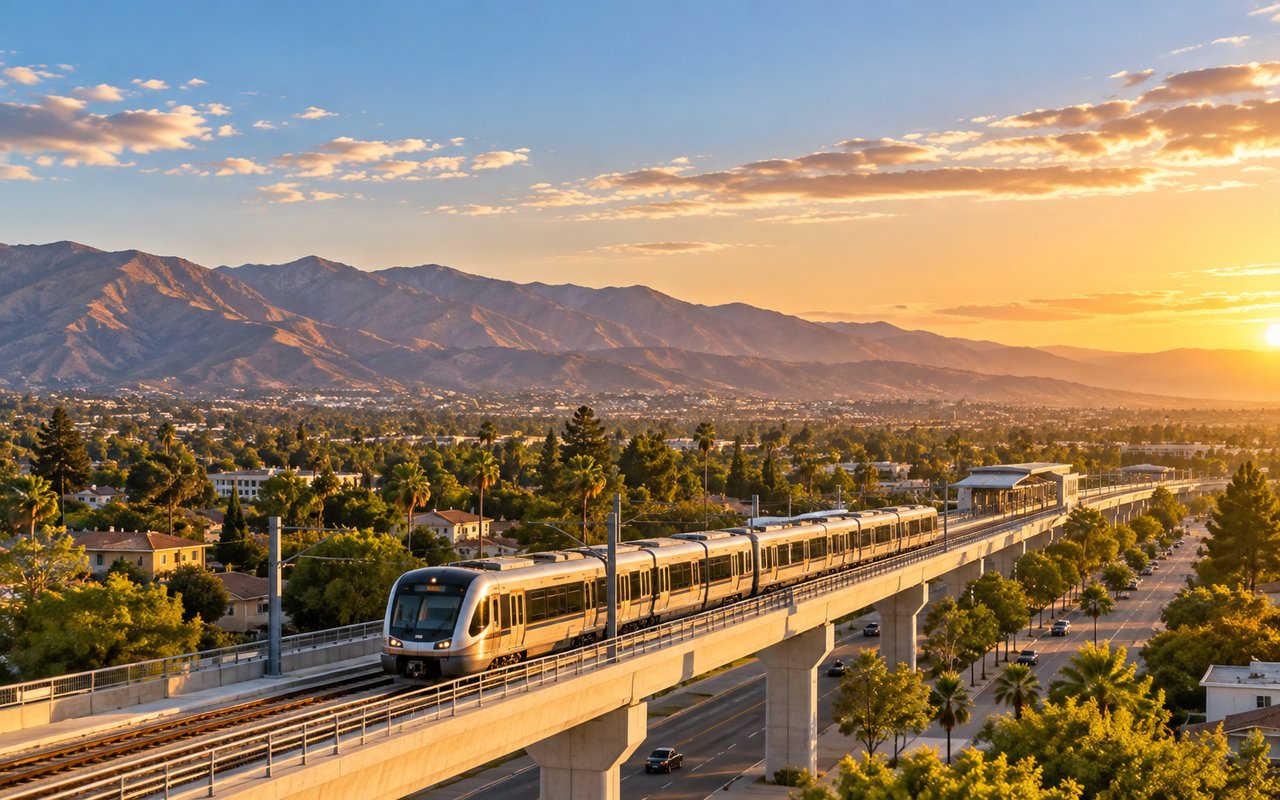
On Monday, October 19, Metro held the groundbreaking for major construction on the East San Fernando Valley Light Rail line. Utility relocation has been underway since 2022, but this marks the start of building the actual guideway, stations and rail yard. When it opens, it will be the first local rail service on Van Nuys Boulevard since the Pacific Electric Red Cars stopped running in 1952.
I've worked in Valley real estate and finance since 1997, and I've seen plenty of transit plans announced, studied, and delayed. This one is now funded and under construction, which is why it's worth a clear-eyed look.
Below: what's actually being built, where prices stand along the corridor, what the research says about rail and home values, and what the new state zoning law does (and doesn't) mean for this part of the Valley.
The facts: 6.7 miles, 11 stations, early 2032
The line runs at street level in the center median of Van Nuys Boulevard, from the G Line busway in Van Nuys north to San Fernando Road in Pacoima. Stations are spaced roughly three-quarters of a mile apart:
- Van Nuys G Line
- Victory
- Vanowen
- Sherman Way
- Van Nuys Metrolink
- Roscoe
- Nordhoff
- Woodman
- Arleta
- Laurel Canyon
- San Fernando
The numbers worth knowing:
- Cost and timing: nearly $4 billion, with Metro's project page listing early 2032 for completion. When the Metro Board approved the project in 2018, the estimate was $1.3 billion and opening was planned for 2027.
- Service: Metro expects trains every 7 to 10 minutes at peak.
- Funding: Measure M, state sources, federal grants and the federal Infrastructure Investment and Jobs Act.
- Connections: the G Line, the Van Nuys Metrolink and Amtrak station, and a planned transfer to the future Sepulveda Pass rail line to the Westside.
- Rail yard: a 26-acre maintenance and storage facility in Van Nuys, west of Van Nuys Boulevard, bounded by Keswick Street, Raymer Street and the Pacoima Wash.
- Not yet funded: a 2.5-mile northern extension to the Sylmar/San Fernando Metrolink station, which Metro is still studying.
One more number that matters for anyone who owns rentals here: according to Metro, about 19% of households along the corridor don't own a car.
Where prices stand along the corridor
The Valley overall is cooling off a record summer. The Southland Regional Association of Realtors reported a Valley single-family median of $1,101,000 in September, down 4.3% from a year earlier and below June's record of $1,188,000. September closed escrows also dropped sharply.
The neighborhoods along this line trade well below that Valley-wide figure:
Neighborhood | Median sale price | Period | Source |
|---|---|---|---|
Panorama City | $725,000 | Sept 2026 | |
Arleta | $759,000 | July 2026 | |
Van Nuys | $778,000 | March 2026 | |
Pacoima Town Center | $718,000 | Feb 2026 | |
San Fernando Valley (single-family) | $1,101,000 | Sept 2026 |
A fair caveat: Redfin's neighborhood figures cover all home types, including condos, while SRAR's figure is single-family only, so this isn't an exact like-for-like comparison. The direction is still clear. These are some of the most attainable neighborhoods in the Valley, and they are the ones getting the train.
What the research says about rail and home values
The evidence is encouraging, but it isn't a guarantee, and it's worth reading carefully.
A 2024 peer-reviewed study in the Journal of Planning Education and Research looked at 20 years of single-family sales in Los Angeles around the Gold Line (now the L Line). It found that light rail openings generally raised nearby property values, but the effect differed by neighborhood income level. A study by the National Association of Realtors and the American Public Transportation Association covered seven metros, including LA, and found residential properties near transit sold at median prices 4% to 24% higher from 2012 to 2016. That study grouped rail and bus rapid transit, so it isn't a light-rail-only number.
My read: rail is a long-term amenity, not a short-term trade. The studies measure what happens once lines are open and in use, and this one is roughly six years out. It also runs at street level down the middle of the boulevard. Homes in the walkable area around a station get the access; properties fronting the boulevard itself also live with the trains, the traffic changes, and the lost curb parking. Those are not the same investment.
SB 79: what it does and doesn't mean for the East Valley
You may have heard that the new state law SB 79 lets developers build eight-story buildings next to light rail stations. That's broadly true statewide, but here in the East Valley, the near-term picture is different.
What the law does. SB 79 took effect July 1, 2026. It allows denser housing on residential, mixed-use, and commercial sites within a half-mile of qualifying transit stops. Planned stations can qualify if the route has an approved alternative, and LA City Planning's draft map includes all the stations on this line's funded segment as Tier 2 stops. The unfunded northern extension was left off.
What LA did with it. The law lets cities delay it in certain areas. In its February 2026 analysis, City Planning found every one of the East Valley line's station areas eligible for that delay, mostly because they fall in what the state's opportunity maps classify as lower-opportunity areas. In June, the City Council adopted ordinances that pause SB 79 citywide until about 2030 and steer near-term upzoning toward 55 "Opportunity Stations" identified in that analysis. None of this line's stations is on that list.
What that means for owners today. SB 79 by itself doesn't change what you can build on Van Nuys Boulevard right now. Two things matter more:
- Existing zoning already varies a lot by station. The city's modeling shows that around the Victory, Vanowen, Sherman Way, Roscoe, and Nordhoff stations, current zoning and city incentive programs already allow more housing units than SB 79 would. Around Arleta, Laurel Canyon, Woodman and San Fernando Road, the opposite is true: those areas are mostly lower-density today.
- 2030 is the date to watch. The delay runs out around 2030, when the city has to adopt its own local plan for these station areas. That is when the zoning conversation for the lower-density stations gets decided.
Two more details for investors. SB 79 excludes sites with three or more rent-stabilized units occupied in the past seven years. And the city is studying whether heavily industrial station areas, such as the area around the Van Nuys Metrolink station, qualify for a permanent exemption as industrial employment hubs.
Eligibility is parcel by parcel, and the official regional map controls, so this is worth checking for any specific property before you buy, sell, or plan a project.
How I'd think about it, depending on where you sit
If you own near the corridor. Don't sell because of construction noise, and don't assume a windfall either. Find out three things about your property: how far it is from the nearest planned station, what it's zoned for today, and whether it sits in an area the city has paused under SB 79. Those answers will matter more to your next buyer than they did to the last one.
If you're buying a home. The broader Valley market has softened since June, which gives buyers more room to negotiate than they had a few months ago. Along the corridor, median prices are running in the $700,000s, well under the Valley-wide single-family median. Buy a home you'd be happy living in through six years of construction, and treat the train as a long-term bonus rather than the reason to buy.
If you're investing or house hacking. Underwrite on today's rents, not on 2032. The fundamentals that exist now are real: a corridor where nearly one in five households doesn't own a car, and medians well below the Valley average. If you're looking at land or redevelopment, know which station area you're in. Some already allow substantial density under current city programs, while others are a bet on how the city rezones around 2030.
The construction years: what to expect
Metro lists major construction running from 2026 to 2032. Along Van Nuys Boulevard, that means phased lane closures and K-rail, and Metro has confirmed some street parking will be removed. The existing bike lanes on Van Nuys are being replaced with new lanes on Terra Bella Street.
If you own or run a small business on the boulevard, two Metro programs are worth knowing about. The Business Interruption Fund offers grants of up to $60,000 per impact year to eligible small businesses along the alignment that can document revenue loss. Eat Shop Play is a marketing program for local businesses during construction. Metro also holds quarterly community meetings and posts active work notices and street closures on its project page.
And a word on timing: this project has already slipped five years from its original 2027 opening. I'd plan around early 2032, but I wouldn't set my watch by it.
The bottom line
The East Valley has waited more than 70 years for rail to come back, and it is now under construction. The train itself is a long-term story. The zoning question is a 2030 story. And the market today, with softer prices and more negotiating room, is its own story. Smart decisions along this corridor come from keeping those three timelines separate.
If you own, rent, or are thinking about buying anywhere from Van Nuys to Pacoima and want to know what this means for a specific property, reach out. I'm happy to pull the zoning, the station distance, and the recent sales and walk through it with you.
Justin Bonney, Founding Broker, Clear Way Real Estate, CA DRE #01338897