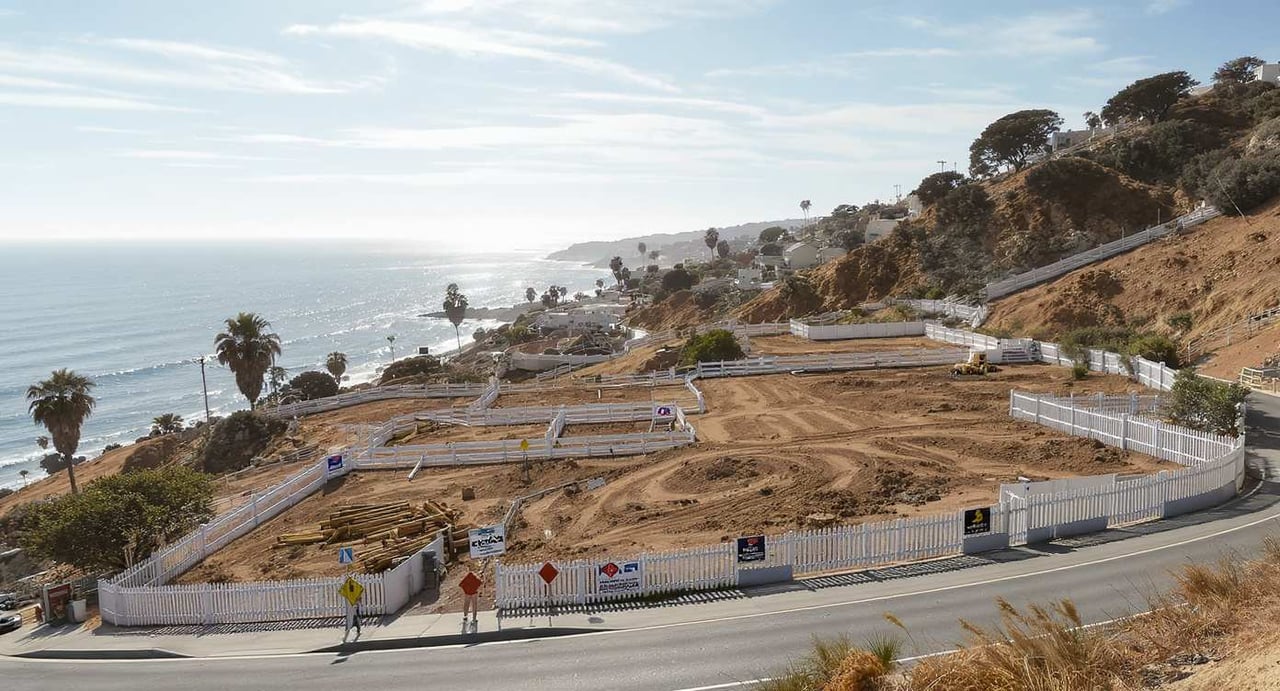
Selling a Fire-Destroyed Lot and Using Prop 19 to Buy Your Next Home
By Justin Bonney, Broker/Founder, Clear Way Real Estate. Licensed since 2002, broker since 2008, DRE #01338897. Updated November 2026.
The short answer
If the Palisades or Eaton fire destroyed the home you lived in, you can usually sell the lot as it is and carry your old, lower property tax base to a new home anywhere in California. That is the disaster transfer in Proposition 19, written into Revenue and Taxation Code section 69.6.¹ The key rules:
- The home had to be your principal residence when the fire hit, and it had to be substantially damaged or destroyed (more than 50% of the land's or the improvements' pre-fire value).¹ ³
- You sell the property in its damaged state. If you rebuild first and then sell, this transfer no longer applies.³
- You buy or build the replacement home within two years of the lot sale (before or after).¹ ³
- The replacement can be any price. If it costs more than the value limit, the difference is added to your carried-over tax base.¹ ²
- You file form BOE-19-V with the Assessor of the county where the new home is, within three years of buying it.⁶ ⁸
These rules come from the statute, the State Board of Equalization (BOE), and the LA County Assessor, cited below. Before you sign anything, confirm your situation with the Assessor's office and a tax professional. This article explains the rules. It is not tax or legal advice.
Who qualifies
You likely qualify for the Prop 19 disaster transfer if all of these are true:¹ ³ ⁶
- You owned and lived in the home as your principal residence just before the fire. That generally means it was eligible for the homeowners' exemption (or the disabled veterans' exemption).
- The fire caused damage of more than 50% of either the land's or the improvements' full cash value immediately before the fire. A home lost in the Palisades or Eaton fire typically meets this, but the Assessor makes the call.
- You sell the original property in its damaged condition. A vacant lot counts; BOE's own example is a destroyed home whose vacant lot later sold.⁴ A rebuilt house does not.³
- You buy or build a replacement home and live in it as your principal residence when you file the claim.¹
- The claimant is an individual. A trust works if you are the present beneficiary. Property held by an LLC, partnership, or corporation does not qualify.¹ ⁵
There is no age requirement for fire victims.³ You only need to meet one of the three Prop 19 categories (age 55 or older, severely disabled, or disaster victim) as of the day the original property sells.²
How the value test works
The Assessor compares two numbers:
- Your old home's full cash value immediately before the fire, as the Assessor determines it. It is not the price your lot sold for after the fire.¹ ³
- The replacement home's full cash value on the date you buy it or finish building it.¹
If the replacement is of "equal or lesser value," your pre-fire factored base year value moves over with no add-on. "Equal or lesser" depends on timing:¹ ²
When you buy or finish building the replacement | Replacement can be up to this share of the old home's pre-fire value |
|---|---|
Before the lot sells | 100% |
Within the first year after the lot sells | 105% |
Within the second year after the lot sells | 110% |
If the replacement is worth more than that limit, you still get a transfer. The amount above the limit is added to your carried-over tax base.¹ ²
BOE's own example:³ A home destroyed by wildfire had a pre-fire full cash value of $650,000. The lot sold in its damaged state, and the owner bought a replacement for $700,000 within the first year after the sale. The limit is 105% of $650,000, or $682,500. Applying the statute's formula to those numbers, the $17,500 above the limit is added to the transferred base year value instead of the whole home being reassessed at $700,000.
The base year value you carry over is your old home's factored base year value just before the fire, plus the normal inflation factoring up to when you buy the replacement.³ ⁴
What counts as a replacement home
Under the statute, a replacement dwelling is a building, structure, or other shelter that you own and live in as your principal residence, plus the land under it (a reasonable homesite).¹ In practice:
- A single-family home, condo, or townhome you live in. Each unit of a multiunit building counts as its own dwelling.¹
- A home with an ADU or JADU still counts as one home, as long as the ADUs can't be sold separately and you live in one of the units.¹
- A manufactured home can qualify.¹ ⁶
- A home you build. You can buy a lot at any time, but construction must be completed within two years of your fire lot's sale, and the lot plus new home must meet the value test on the completion date.³
- Anywhere in California. The replacement does not have to be in LA County.¹ ⁸
A rental property, second home, or investment property does not qualify. It has to be where you live.¹
Step by step: selling your lot and moving your tax base
- Confirm your pre-fire status. Pull your last pre-fire property tax bill and check that the homeowners' exemption was on the property. If it wasn't, call the Assessor before you plan around this transfer.
- File, or confirm you filed, your misfortune and calamity claim. This temporarily lowers the assessed value of the damaged property. For the January 2025 LA fires, the filing deadline is 24 months from the date of damage, or the time set in the county ordinance if that is longer.⁶ In LA County the form is ADS-820.⁹
- Decide: rebuild or sell. If you rebuild a comparable home on your lot, you keep your base year value, and for the Palisades and Eaton fires the rebuild window is eight years.⁶ ¹⁰ If you sell and transfer, you can't also take the rebuild benefit for the same loss.⁶ ⁷
- Sell the lot in its damaged state. BOE's guidance treats a vacant lot sale as a sale in damaged condition.⁴ What matters is that you did not rebuild before selling. Your two-year clock starts on the date of sale.¹ ³
- Shop for the replacement with the value test in mind. Know your old home's pre-fire value (ask the Assessor's office how they will determine it), and time your purchase. Buying in year two gives you the most room (110%).¹
- Buy or finish building the replacement within two years of the lot sale. If you buy first, BOE notes you will pay taxes on the replacement's full market value until the lot sells, with no refund for that period.²
- Move in. The replacement must be your principal residence when you file. File the homeowners' exemption claim (BOE-266) on the new home too.¹ ⁹
- File form BOE-19-V with the Assessor of the county where the replacement is located. This is not done through escrow. You file after both transactions close and you are living in the new home.² ⁶
- File within three years of buying or completing the replacement. A late claim only gets relief going forward from the year you file.¹ ⁴
Timing and deadlines at a glance
What | Deadline | Source |
|---|---|---|
Buy or finish building the replacement (Prop 19) | Within 2 years of the lot sale, before or after | ¹ ³ |
File BOE-19-V (Prop 19) | Within 3 years of buying or completing the replacement; late claims get prospective relief only | ¹ ⁶ |
Misfortune and calamity claim (Jan 2025 LA fires) | 24 months from the date of damage, or the county ordinance period | ⁶ |
Rebuild on your own lot and keep your base year (Palisades, Eaton) | 8 years from the fire | ⁶ ¹⁰ |
Same-county transfer under Prop 50 (section 69) | Replacement within 5 years of the fire | ⁶ |
Other-county transfer under Prop 171 (section 69.3) | Replacement within 3 years of the fire; claim within 3 years of buying | ⁶ |
If you sold your lot early in 2025, your two-year Prop 19 window may already be running out. Check your closing date.
Other routes worth comparing
Prop 19 is not the only option. BOE lists three disaster base year value transfers, and the older two still exist alongside Prop 19:⁴ ⁶
Same county (Prop 50, Revenue and Taxation Code section 69). You can move your base year value to a comparable replacement property in the same county within five years of the fire. You do not have to sell the damaged property. It works for any property type, not just your home, but the replacement must be similar in size, utility, and function, and value above 120% of the pre-fire value is assessed at market value. Form BOE-65-P.⁶ ⁹
Another county with an ordinance (Prop 171, section 69.3). For a principal residence, you can transfer to one of 14 counties that accept these transfers: Contra Costa, Glenn, Los Angeles, Modoc, Orange, San Diego, San Francisco, Santa Clara, Solano, Sonoma, Sutter, Ventura, Yolo, and Yuba. The replacement must be bought within three years of the fire and stay within 105%, 110%, or 115% of the pre-fire value, depending on the year. Form BOE-65-PT.⁶
Rebuild on your lot (section 70.5). If you rebuild a comparable home, your base year value is reinstated, and for the January 2025 Palisades and Eaton fires the window is eight years. You can't also transfer the base year value to another property.⁶ ¹⁰
Age 55 or older, or severely disabled (also Prop 19). If you rebuilt and later sell, you are no longer a disaster "victim" for this rule, but you may still transfer your base year value under the age 55+ or disability rules, up to three times. Forms BOE-19-B (55+) or BOE-19-D with BOE-19-DC (disability).² ³
Which route is best depends on where you want to live, whether you want to sell, and the numbers. This is where a call with the Assessor's office and a tax professional pays off.
What to have ready
- Your APN and your last pre-fire property tax bill
- Proof the home was your principal residence on the fire date (homeowners' exemption on record, plus documents your tax professional suggests)
- Your misfortune and calamity claim (ADS-820) and any reassessment notices from the Assessor
- Debris-removal status and sign-off paperwork
- The lot's closing statement, showing the sale date
- The replacement home's closing statement or certificate of occupancy (for new construction)
- How title is held on both properties (individual names or your trust)
- Insurance claim status and any loan payoff information
Frequently asked questions
Can I sell my burned lot and keep my property tax base? Usually, yes. Under Proposition 19 (Revenue and Taxation Code section 69.6), if the home was your principal residence when the fire hit and it was substantially damaged or destroyed, you can sell the lot in its damaged state and transfer your pre-fire factored base year value to a replacement home anywhere in California. The replacement must be purchased or newly constructed within two years of the lot sale, and you file form BOE-19-V with the Assessor of the county where the replacement home is located.
How long do I have to buy a replacement home after I sell my lot? Two years from the date the lot sells. You can also buy the replacement first, as long as the lot sells within two years of that purchase. If you build instead of buy, construction has to be completed within two years of the lot sale.
Does the replacement home have to cost less than my old home? No. You can buy a replacement of any value. If it costs more than the value limit (100%, 105% or 110% of your old home's pre-fire market value, depending on timing), the difference is added to the tax base you carry over. You keep a partial benefit instead of losing it.
Which form do Palisades and Eaton fire victims file? Form BOE-19-V, Claim for Transfer of Base Year Value to Replacement Primary Residence for Victims of Wildfire or Other Natural Disaster. File it with the Assessor of the county where your replacement home is located, after both transactions close and you are living in the new home. Form BOE-19-D is a different form for severely disabled persons.
When is the deadline to file the Prop 19 claim? Within three years of buying the replacement home or completing its construction. If you file later, the Assessor can still grant the transfer, but only going forward from the year you file, with no refund for earlier years.
Does using the fire transfer count against my three Prop 19 transfers for age 55 and older? No. The three-time limit applies to transfers claimed for age or disability. Per the State Board of Equalization, a disaster base year value transfer does not count toward that limit.
Can I rebuild on my lot and also transfer my tax base to another home? No. You choose one path. Rebuilding a comparable home on your lot keeps your base year value (and for the January 2025 Palisades and Eaton fires, the rebuild window is eight years), but you cannot also take a base year value transfer to another property for the same loss.
Let's talk about your lot and your next home
If you're weighing whether to sell your lot and move, call me at (818) 697-4884. I'll walk you through what lots near yours have been selling for, map your two-year Prop 19 window against your timeline, and put together a no-pressure net sheet. For the tax questions, I'll point you to the Assessor's office and your tax professional to confirm the numbers.
Want more on pricing and selling the lot itself? Read Selling Your Pacific Palisades Lot After the Fire.
Selling in Altadena? See selling an Altadena lot after the Eaton Fire.
Justin Bonney, Broker/Founder, Clear Way Real Estate · DRE #01338897 · (818) 697-4884
Sources
¹ California Revenue and Taxation Code section 69.6 (implements Prop 19 base year value transfers; amended by Stats. 2023, ch. 312). https://leginfo.legislature.ca.gov/faces/codes_displaySection.xhtml?lawCode=RTC§ionNum=69.6 ² California State Board of Equalization, "Proposition 19" (comparison charts, FAQs, and filing requirements checklist). Accessed Nov 16, 2026. https://www.boe.ca.gov/prop19/ ³ BOE, Letter to Assessors No. 2024/044, "Proposition 19 Base Year Value Transfer Frequently Asked Questions and Answers," Dec 11, 2024. https://www.boe.ca.gov/proptaxes/pdf/lta24044.pdf ⁴ BOE, Letter to Assessors No. 2021/026, "Base Year Value Transfers for Governor-Proclaimed Disasters," June 25, 2021. https://www.boe.ca.gov/proptaxes/pdf/lta21026.pdf ⁵ BOE, Letter to Assessors No. 2022/009, "Implementation of Proposition 19: Base Year Value Transfers." https://www.boe.ca.gov/proptaxes/pdf/lta22009.pdf ⁶ BOE, Letter to Assessors No. 2026/022, "Updated Information Guide for Disaster Relief for Damaged or Destroyed Property (Publication 802)," May 29, 2026. https://www.boe.ca.gov/proptaxes/pdf/lta26022.pdf ⁷ BOE, "Disaster Relief." Accessed Nov 16, 2026. https://www.boe.ca.gov/proptaxes/disaster-relief.htm ⁸ Los Angeles County Assessor, "Proposition 19." Accessed Nov 16, 2026. https://assessor.lacounty.gov/tax-relief/prop19 ⁹ Los Angeles County Assessor, "Forms" (BOE-19-V, BOE-19-B, BOE-19-D, BOE-65-P, BOE-65-PT, BOE-266, ADS-820). Accessed Nov 16, 2026. https://assessor.lacounty.gov/forms ¹⁰ AB 245 (Stats. 2025, ch. 530) and SB 663 (Stats. 2025, ch. 549), amending Revenue and Taxation Code section 70.5. https://leginfo.legislature.ca.gov/faces/billTextClient.xhtml?bill_id=202520260AB245 and https://leginfo.legislature.ca.gov/faces/billTextClient.xhtml?bill_id=202520260SB663
General information only, not tax or legal advice. Rules can change, and the Assessor decides each claim. Confirm your situation with the Los Angeles County Assessor, (213) 974-3211, and a qualified tax professional before you act.