The Conversation Nobody's Having With You
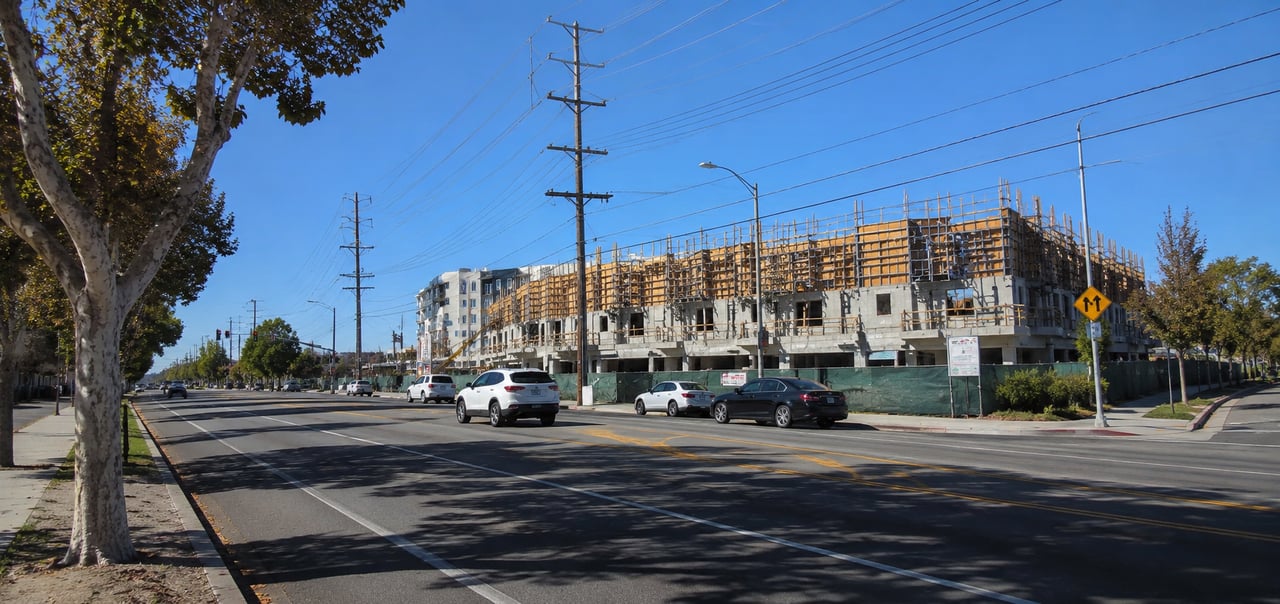
A client in Van Nuys called me last month to say, "There's a huge construction project going up on my block and nobody told me what it is." I pulled the permit records, showed her the approved plans for a 40-unit apartment building, and explained what it would likely do to her home value. That conversation shouldn't require a phone call to an agent. Here's everything being built in the San Fernando Valley right now, by neighborhood.
New development changes neighborhoods. It can increase property values when it brings new retail, transit improvements, and community amenities. It can create concerns when it adds density, traffic, and parking competition. Knowledge is power, and most homeowners and buyers have no idea what's being built near them until the construction fences go up.
How to Track Development Yourself
Before I get into the neighborhood-by-neighborhood breakdown, here are the tools you can use to track development on your own:
LADBS (LA Department of Building and Safety) online portal: Search any address and see every permit ever pulled. Open permits, final permits, pending applications. This tells you what's being built and whether it's legal.
LA City Planning case search (ZIMAS): The Zone Information and Map Access System shows you zoning, planning cases, environmental reviews, and proposed projects for any parcel in the City of LA. It's the most comprehensive tool for understanding what's approved and what's proposed.
Neighborhood Council agendas: Your local neighborhood council reviews and votes on development projects. Their monthly agendas and minutes are public record and often contain project details before LADBS permits are filed.
LA City Planning Commission and City Council files: Major projects require commission and council approval. These hearings are public, and the files are accessible online.
I encourage every homeowner to check ZIMAS for their block at least once a year. It takes five minutes and might tell you something important.
Ventura Boulevard Corridor
Ventura Boulevard is the spine of the San Fernando Valley, and it's seeing the most concentrated mixed-use development activity.
Sherman Oaks: Multiple mixed-use projects are in various stages of approval and construction along Ventura Blvd between Van Nuys Blvd and Sepulveda Blvd. These are typically 4-5 story buildings with ground-floor retail and residential units above. They're changing the character of the boulevard from strip-mall commercial to a more urban, walkable feel.
Impact: Positive for nearby residential property values long-term. More retail, more foot traffic, and a more desirable boulevard experience increase the "south of Ventura" premium. Short-term construction disruption is real but temporary.
Encino: More limited development than Sherman Oaks. The Encino section of Ventura Blvd has stronger community resistance to density, which has slowed but not stopped mixed-use proposals. Several smaller projects are approved or under review.
Woodland Hills: The western stretch of Ventura Blvd is seeing new restaurant and retail openings rather than major construction projects. The Warner Center area adjacent to Woodland Hills has more significant development activity.
Warner Center
Warner Center is the Valley's major development story. This planned urban center in the west Valley has been building out for years, with office towers, residential towers, and mixed-use projects that are transforming it into a legitimate urban hub.
Current and upcoming projects include large-scale residential developments (some over 300 units), new office construction, and the ongoing evolution of the Westfield Topanga and Village shopping complex. Warner Center has its own specific plan that allows greater density than most Valley neighborhoods.
Impact: Positive for Woodland Hills and Canoga Park residential values. Job growth and amenity development in Warner Center increase demand for nearby housing. For Woodland Hills specifically, Warner Center's growth is a major driver of the neighborhood's appeal.
Van Nuys
Van Nuys has more active large-scale development projects than almost any other Valley neighborhood. Several hundred-unit apartment buildings are approved or under construction, particularly along Van Nuys Boulevard and near the future Metro B Line extension.
The Metro B Line extension is the transformative project for Van Nuys. When completed, it will bring subway service down Van Nuys Boulevard, connecting the Valley to the Westside. The stations are driving transit-oriented development: taller, denser residential and mixed-use buildings within a quarter-mile of planned stations.
Impact: Mixed. Transit access will increase property values near stations long-term. Short-term (during construction), expect disruption on Van Nuys Blvd. For residential homeowners on side streets, the impact depends on proximity. Being near a station is generally positive for value. Being next to a large apartment building may affect your daily experience.
North Hollywood
The NoHo Arts District continues to expand, with new mixed-use projects pushing the boundaries of the original Arts District further north and east. Apartment and condo developments are active, driven by Metro Red/B Line access and the entertainment industry's concentration in the area.
Impact: North Hollywood development is spilling over into Valley Glen and driving appreciation in that neighboring area. For Valley Glen homeowners, the NoHo development story is a positive. For North Hollywood residents, the neighborhood character is changing rapidly from single-family residential to a denser, more urban environment.
Porter Ranch
Porter Ranch new construction is builder-driven: new single-family home communities from Toll Brothers, KB Home, and other builders. This is different from the infill development happening in central Valley neighborhoods. Porter Ranch is expanding at the edges with planned communities.
Impact: New construction communities add to Porter Ranch's supply, which provides competition for existing homeowners trying to sell. However, the community amenities, modern product, and buyer demand support continued value growth. The bigger concern for Porter Ranch is fire risk in the hillside areas and the infrastructure capacity of Aliso Canyon.
Reseda and Lake Balboa
Development activity in Reseda and Lake Balboa is smaller in scale but meaningful in aggregate. Individual lot development (new duplexes, small apartment buildings replacing single-family homes) is happening scattered across both neighborhoods.
The bigger story is the ADU boom. Lake Balboa in particular has one of the highest concentrations of new ADU construction in the Valley. While individual ADUs don't require major development approvals, the cumulative effect on neighborhood character, parking, and rental supply is significant.
Impact: ADU construction is generally positive for property values (it increases the utility of individual lots). But on blocks where every other home has an ADU, the increased density changes the feel. Parking becomes tighter. The single-family character evolves.
The Valley-Wide ADU Wave
This deserves its own section because it's the most significant development trend in the Valley, and it's not driven by big developers. It's individual homeowners building secondary units on their own lots.
California's ADU laws (AB 68, SB 13, and subsequent legislation) have made it easier and cheaper to build ADUs. The Valley's large lot sizes (particularly in Lake Balboa, Van Nuys, Reseda, Northridge, and Valley Glen) make ADU construction physically feasible on a scale that denser neighborhoods can't match.
The numbers tell the story: ADU permit applications in the San Fernando Valley have increased dramatically since 2020. In neighborhoods like Lake Balboa, it's not unusual to see ADU construction happening on every other block.
What this means for the market:
- Rental supply is increasing. More ADUs means more rental inventory, which moderates rent growth.
- Property values for ADU-equipped homes are higher. A permitted, tenanted ADU adds $80,000 to $150,000 to a home's value depending on the unit and the neighborhood.
- Neighborhood character is changing. Blocks that were exclusively single-family are becoming denser. More residents, more cars, different feel.
Transit-Oriented Development
The Metro expansion is the biggest driver of large-scale development planning in the Valley. Two projects matter most:
Metro B Line extension (formerly Purple Line equivalent, Van Nuys corridor): This is the future subway line running down Van Nuys Boulevard. Stations are planned at major intersections, and each station is generating transit-oriented development proposals within a quarter-mile radius. This will fundamentally change the character of the Van Nuys Boulevard corridor over the next decade.
Metro G Line (Orange Line) stations: Already operational, the G Line stations in Reseda, Lake Balboa, Van Nuys, and North Hollywood continue to attract development. The areas immediately around these stations are seeing increased density as developers build to capitalize on transit access.
Impact on nearby home values: Generally positive at a 5-10 year horizon. Improved transit access increases neighborhood desirability. However, the construction period and early years of operation can create disruption that temporarily depresses values for immediately adjacent properties.
How to Assess Impact on Your Home
Not all development is equal, and the impact on your home value depends on several factors:
Type of project matters. New retail and restaurants generally help nearby values. New parks and transit improvements help. Large apartment buildings within a block can be mixed. Industrial or warehouse projects generally don't help residential values.
Distance matters. Being two blocks from a new restaurant row is great. Being next door to a construction site is not. The sweet spot is close enough to benefit from amenities, far enough to avoid direct impacts.
Scale matters. A neighbor building an ADU is different from a developer building a 200-unit apartment building. The larger the project, the greater the traffic, parking, and density impact.
Timeline matters. Construction periods are temporary. The long-term value impact of quality development is usually positive. Don't panic about a 12-month construction project if the finished product improves the neighborhood.
Stay Informed
Check ZIMAS for your address. Attend your neighborhood council meeting. Pull the LADBS records for the construction happening on your block. This information is public and accessible. The homeowners who stay informed make better decisions about when to sell, what to improve, and how to plan.
If you want to know what's being built near your specific property and what it means for your home value, call me. I'll pull the records and give you an honest assessment.
Justin Bonney is a California real estate agent (DRE #01338897) and the owner of Clear Way Real Estate in Sherman Oaks. He specializes in the San Fernando Valley and tracks development activity across the region.