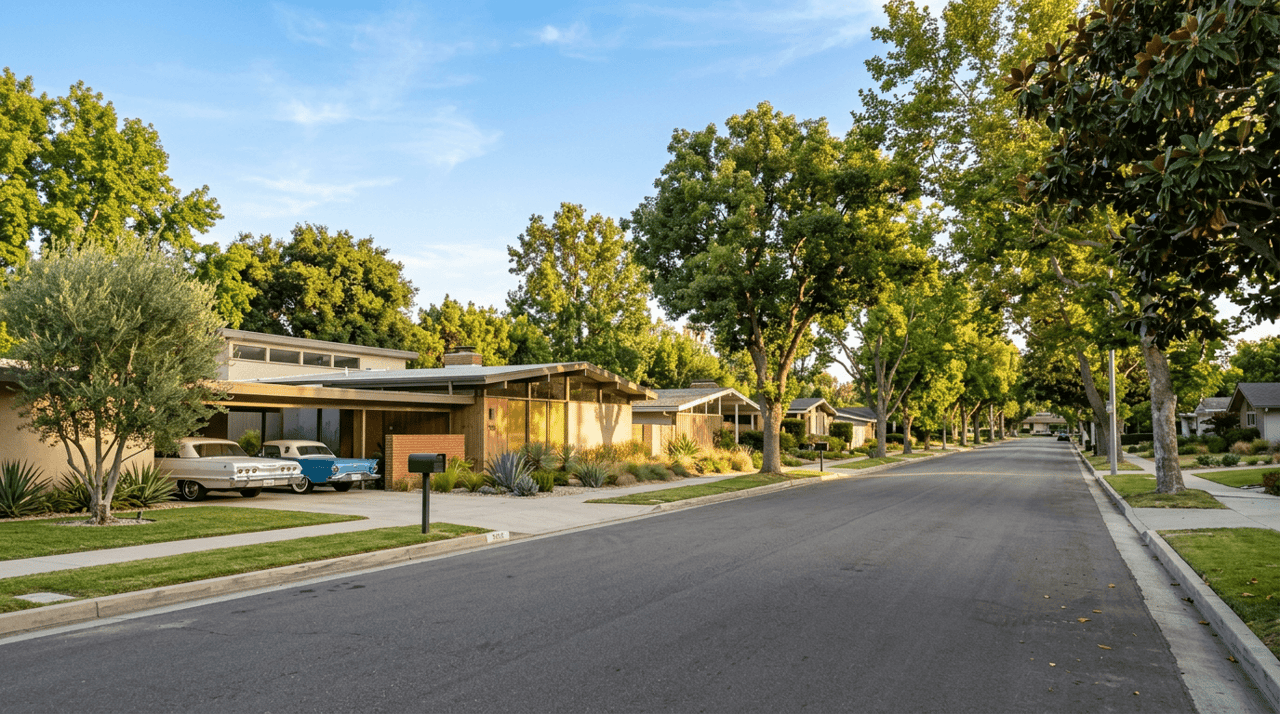
When people think mid-century modern in Los Angeles, they think Silver Lake or Los Feliz. And they're wrong to stop there. The San Fernando Valley has some of the most concentrated pockets of mid-century architecture in the entire city, from Palmer & Krisel tract homes in Granada Hills and Northridge to architect-designed one-offs in Encino and Sherman Oaks.
I know what you're thinking. The Valley? Really? But here's the thing: while everyone else is fighting over a 1,200 square-foot Silver Lake bungalow listed at $1.8 million, you could be buying a gorgeously restored mid-century modern home in the Valley with actual square footage, an actual yard, and money left in your bank account. It's not a secret anymore, but it's still a significantly better value than the Eastside, and the architecture is just as authentic.
Let me show you where to look.
The San Fernando Valley's Unexpected Mid-Century Legacy
The Valley's mid-century modern story is deeply tied to post-war suburban expansion. After World War II, returning servicemen needed affordable housing, and developers needed to build it fast. The San Fernando Valley became ground zero for large-scale residential development, which meant volume builders had to innovate on cost and design. That's where the magic happened.
Unlike the custom homes and bungalow courts of older neighborhoods, the Valley's mid-century homes were planned communities, which meant consistency, efficiency, and a stunning number of well-designed tract homes built by forward-thinking developers and architects. Open floor plans. Clean lines. Indoor-outdoor living. The whole package.
Palmer & Krisel: The Kings of Valley Mid-Century Development
If you're serious about mid-century modern homes in the Valley, you need to know Palmer & Krisel.
They didn't design boutique homes for wealthy clients. They designed smart, buildable, beautiful homes that regular people could afford. Their influence is everywhere in the Valley.
You'll find the heaviest concentration of Palmer & Krisel homes in:
Granada Hills — the largest and most concentrated pocket. Thousands of their designs throughout the neighborhood, including the celebrated Balboa Highlands tract, one of the most architecturally significant Palmer & Krisel groupings in Los Angeles.
Northridge — equally significant Palmer & Krisel territory, with entire neighborhoods defined by their flat-roofed, post-and-beam aesthetic. The standout is the Living-Conditioned Homes tract at the northeastern corner of Reseda Boulevard and Devonshire Street, built 1958-1959. According to the LA Conservancy, this is the only Palmer & Krisel tract in the Valley exhibiting their flamboyant "Alexander style" with butterfly roofs, decorative stone cladding, and extensive use of decorative concrete block, the same design language that made their Palm Springs work iconic. Many homes have been painstakingly restored to their original condition.
North Hills — more scattered, but still substantial holdings.
Corbin Palms in Woodland Hills — most people associate Palmer & Krisel with their Palm Springs work, but Corbin Palms is one of their most significant tracts outside the desert. It sits on the edge of Woodland Hills, where the neighborhood abuts Reseda and Tarzana. Many of these homes were aggressively remodeled in the 1990s and 2000s, stripped of original architectural integrity in favor of generic Mediterranean and contemporary updates. There has been a real resurgence of appreciation for original-condition Palmer & Krisel homes in the last several years, which is shifting the market for the few that survived intact. If you find one with original features still in place, that home is worth taking seriously. For a deeper background on Palmer & Krisel's broader work, USModernist's archive on the Marlborough Palms tract is one of the better resources online.
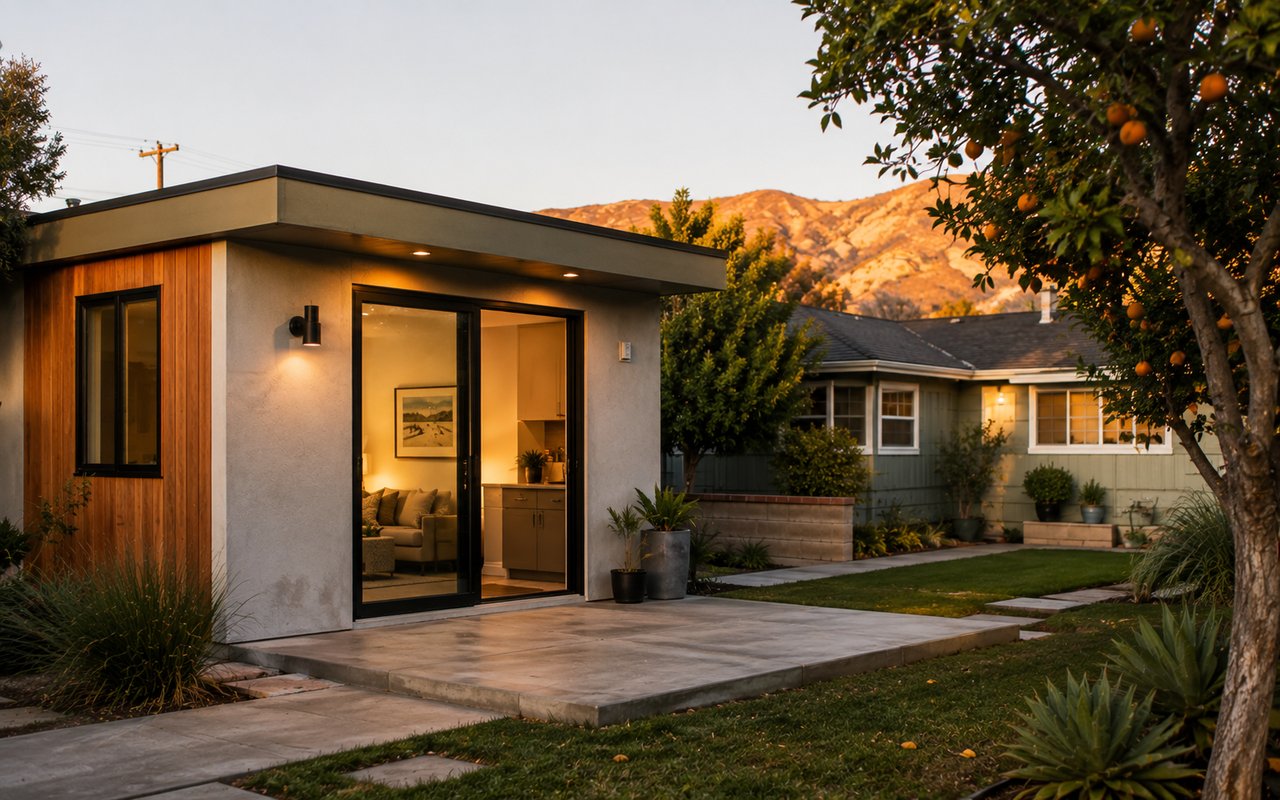
What defines a Palmer & Krisel home? The signature features are unmistakable: clean flat rooflines, post-and-beam construction, open floor plans, large glass sliding doors that dissolve the line between inside and outside, and integrated carports. They built for the California lifestyle, which meant indoor-outdoor living wasn't a luxury. It was the whole point.
The homes are typically 1,200 to 2,000 square feet, sit on larger lots than comparable Eastside properties, and represent some of the best value in authentic mid-century modern architecture anywhere in Los Angeles.
Charles Du Bois: Woodland Hills' Hidden Mid-Century Master
Charles Du Bois is one of the more underappreciated mid-century architects working in the Valley, and that is changing fast. His most significant body of work is the Woodland West Tract in Woodland Hills, where his mid-century ranches have become prized remodel projects for developer-flippers in the last several years. When a Du Bois home in Woodland West hits the market in original or near-original condition, it draws competitive offers from buyers who know what they are looking at.
Du Bois also designed a small handful of one-off homes in Lake Balboa: just four on Louise Avenue, all well-laid-out mid-century ranchers, though several have been reconfigured over the decades. Their exteriors lean more toward "Cinderella" than pure mid-century modern, but the bones and floor plans hold up. If you know what to look for, they stand out from the surrounding postwar tract homes. I track these specifically because most agents do not know they exist, and that asymmetric knowledge matters when pricing or marketing one.
Edward Fickett: The Quiet Workhorse of Valley Mid-Century
Edward Fickett designed hundreds of homes across Los Angeles, and the San Fernando Valley holds the heaviest concentration. His work spans affordable tract developments and custom hillside homes, all carrying the same disciplined, intelligent design language that has made his name increasingly sought after by serious mid-century buyers.
Where you'll find Fickett homes in the Valley:
Reseda — home to the Meadowlark Park development, one of Fickett's most concentrated and recognizable Valley tracts. If you're hunting Fickett at accessible price points, Meadowlark Park is the first place to look.
Van Nuys — significant Fickett groupings in the streets near Coronet Street and Sherman Way.
Woodland Hills and Tarzana — major Fickett concentrations spread across both neighborhoods.
Sherman Oaks — fewer in number, but the quality is exceptional. Look for private, often elevated post-and-beam examples south of Ventura Boulevard, where Fickett did some of his most architecturally ambitious Valley work.
Beyond the Valley, Fickett's footprint spans Los Angeles in pockets worth knowing about:
Hollywood Hills — custom and semi-custom Fickett homes are concentrated in upper Nichols Canyon, including the area sometimes called The Colony. These are steep-site builds with sweeping canyon views and the indoor-outdoor flow that defines great mid-century design.
Los Feliz — home to the Jacobson House, a Historic-Cultural Monument designed by Fickett. One of his most celebrated single-family commissions.
Pacific Palisades — a small but notable collection of Fickett-designed custom homes.
San Pedro — a small, often-overlooked group of Fickett homes that mid-century enthusiasts know to look for.
Fickett's homes show up at slightly more accessible price points than the most famous architect-designed properties, and the design quality is genuinely there. Buyers crossing the Valley to look at Fickett tracts often expand their search across multiple Valley neighborhoods when the pricing math works for a specific home.
Joseph Eichler: Rare and Coveted
Joseph Eichler was a developer and visionary who built mid-century communities throughout California. His homes in the Bay Area are legendary. In the San Fernando Valley, his footprint is smaller but no less significant.
Eichler homes in the Valley are concentrated primarily in Granada Hills, near Balboa Boulevard. His designs share DNA with Palmer & Krisel's work but with a distinctly Eichler touch: minimalist post-and-beam design, glazed walls, radiant floor heating, and an almost philosophical commitment to the modernist ideal. The Eichler Network's "Forgotten Giant" piece is one of the better deep dives on Eichler's Southern California work and a solid starting point for serious buyers.
If you find an original Eichler in the Valley, treat it seriously. They are scarce, authentic, and deeply sought after by collectors and design enthusiasts.
Other Architects Worth Knowing
Richard Neutra — one of the greatest American architects, had only a few commissions in the Valley. When you find one, you have found something special.
Cliff May — the architect who practically invented the California ranch home. You will find some stunning May designs scattered throughout the Valley, particularly in more custom developments.
A. Quincy Jones — a prolific mid-century architect and planner. Some of his designs appear in planned communities throughout the Valley.
These names matter because they signal authenticity and quality. A home designed by any of these architects carries more weight than a tract home, even a beautifully designed one. It is the difference between mass production and individual vision.
Neighborhood-by-Neighborhood Guide
Granada Hills and Northridge: The Mid-Century Heartland
This is where you go if you want density and selection. The largest concentration of Palmer & Krisel homes (including Balboa Highlands and Living-Conditioned Homes), Eichler homes, and architect-designed mid-century modern residences sits here. You could spend a full weekend driving these neighborhoods and never run out of interesting architecture to look at.
What to expect: generously sized lots by Los Angeles standards, strong neighborhood character, and a mix of homes that range from period-original to thoughtfully updated. Pricing depends heavily on architectural pedigree, condition, and the extent to which the original design intent has been preserved, with restored Palmer & Krisel and Eichler homes commanding meaningful premiums over standard tract inventory.
Encino: Custom Mid-Century on Larger Lots
Encino represents a different flavor of Valley mid-century modern. Here, you get architect-designed one-offs rather than tract development. Homes are larger, lots are significantly bigger, and the focus shifts to custom design.
Look at the Amestoy Estates area, where some truly spectacular architect homes sit on substantial lots with serious preservation potential.
What to expect: larger homes and more variation in design. Significant value for the space and land, particularly compared to custom homes in traditional Westside neighborhoods.
Sherman Oaks: Gems in the Right Pockets
Sherman Oaks mid-century modern homes are scattered rather than concentrated, but the quality can be exceptional, particularly south of Ventura Boulevard, where Edward Fickett's elevated post-and-beam custom homes anchor the neighborhood's mid-century inventory. You will find post-and-beam designs with period-appropriate updates, hillside homes with city views, and plenty of properties with great bones waiting for the right buyer.
The lack of concentration actually works in your favor if you are a serious buyer. Less competition, more room to negotiate.
Reseda: Fickett Country
Reseda is one of the more under-the-radar mid-century neighborhoods in the Valley, anchored by Edward Fickett's Meadowlark Park development. This is where you go if you want authentic Fickett at accessible Valley price points. The neighborhood has not yet been fully discovered by the broader mid-century buyer market, which means real opportunity for buyers willing to do the homework.
Woodland Hills and Tarzana: Mid-Century Ranches with Views
These neighborhoods host some of the Valley's most beautiful mid-century ranches, often positioned to take advantage of mountain views and larger lots. The ranch style here is less tract, more custom, with serious architectural intention. Du Bois's Woodland West Tract is the standout; Edward Fickett built major concentrations across both Woodland Hills and Tarzana, and Corbin Palms (on the Reseda/Tarzana edge) represents Palmer & Krisel's largest non-desert tract.
What to expect: properties with land. Quiet neighborhoods. Strong preservation of mid-century character. Prices that reflect the land value and views.
Studio City: Hillside Modern with City Views
Studio City's hillside mid-century modern homes offer something special: city views, tree cover, and an intimate neighborhood feel while still being accessible from the main Valley floor. These homes tend toward the custom-designed end of the spectrum.
Lake Balboa: The Hidden Du Bois Pocket
Most buyers do not know Lake Balboa has any architectural pedigree, and that is part of why this neighborhood remains undervalued. Charles Du Bois designed a small group of one-off mid-century ranchers on Louise Avenue, four in total, and several have been reconfigured over the decades. The exteriors lean more toward "Cinderella" than pure mid-century, but the original floor plans and bones are well executed. For the right buyer who values architectural provenance at a Lake Balboa price point, these homes are worth tracking. I know which ones they are.
What to Look For and What to Watch Out For
You're looking at homes that are 60+ years old. That is not inherently a problem, but it requires knowledge.
Preservation Wins:
- Original flat roofs with proper membrane systems (rebuilt, not patched repeatedly)
- Original post-and-beam structure intact
- Original glass walls or period-appropriate replacements
- Radiant heating systems (if original, worth preserving)
- Original wood flooring
- Original or faithful kitchen updates
- Period-appropriate landscape design
Red Flags That Cost Real Money:
- Flat roofs that leak (extremely common, and fixing them properly often starts in the mid-five figures and goes up from there depending on size, deck condition, and underlying structural damage)
- Single-pane original glass (beautiful, but terrible for energy efficiency)
- Asbestos in flooring, insulation, or drywall (common in homes built in this era)
- Knob-and-tube wiring (a fire hazard that needs replacement)
- Poor drainage or foundation issues (can be hidden by mid-century design)
- Termite damage in posts or beams (catastrophic if ignored)
Get a proper inspection by someone who understands mid-century construction. Standard inspectors sometimes miss issues specific to the design and materials of this era.
Renovation Reality: What It Actually Costs
Here is where I will be honest with you: restoring a mid-century modern home to its original specifications is expensive. Sourcing period-appropriate materials, hiring craftspeople who understand the era, and respecting the original design intent requires investment.
A thoughtful renovation that preserves the character and bones of a mid-century home might run $200,000 to $500,000+, depending on the home's size and condition. That sounds like a lot, but it often represents tremendous value compared to buying a fully restored home at market rates.
Modernization is cheaper but riskier. Rip out the original kitchen for a contemporary one, replace the glass walls with insulated windows, paint over the wood paneling, and you have destroyed what made the home interesting in the first place. The cost savings rarely justify what you have lost.
The best approach: identify the bones and original architectural features worth preserving, update the systems (electrical, plumbing, HVAC) to 21st-century standards, and let the mid-century design shine through. It is a middle path that respects the home's character while making it genuinely livable.
How to Search the MLS for Mid-Century Homes
By Keywords: Search for "mid-century modern," "MCM," "mid century," "post and beam," or architect names like "Palmer Krisel," "Eichler," "Du Bois," or "Fickett."
By Year Built: Set your filters to 1945-1965. Some mid-century homes were built into the early 1970s, but the sweet spot is post-war through the early 1960s.
By Style Tags: Most MLS systems let you filter by architectural style. Look for "mid-century modern," "contemporary," "ranch," or "modern."
By Neighborhood: Once you have identified neighborhoods of interest, browse by area. You will quickly develop an eye for what is mid-century and what is not.
Work with an Agent Who Knows the Era: A real estate agent unfamiliar with mid-century modern architecture might miss what makes a home special or fail to highlight the features that matter to educated buyers. You want someone who can speak credibly about Palmer & Krisel, Du Bois, Fickett, original post-and-beam construction, and the difference between respectful restoration and destructive updating.
Further Reading for Mid-Century Enthusiasts
If you want to go deeper on Valley and Southern California mid-century architecture, a few resources I keep going back to:
- LA Conservancy maintains the most comprehensive database of historic places, tracts, and preservation context across Los Angeles. Their profiles of Living-Conditioned Homes, Balboa Highlands, and Woodland West are excellent starting points for Valley-specific tracts.
- USModernist hosts an unmatched archive of mid-century architectural records, including detailed Palmer & Krisel tract documentation.
- Eichler Network is the authoritative resource on Joseph Eichler, including the Forgotten Giant article on his Southern California footprint.
- Open Space Series is a passionate enthusiast blog with deep, well-researched profiles of both well-known and obscure Southern California architects. One of the best resources for going deep on lesser-known designers.
Time to Look
The San Fernando Valley's mid-century modern homes represent some of the most authentic, affordable, and architecturally significant properties you can buy in Los Angeles right now. The market is becoming more aware of their value, which means inventory is tightening and prices are moving up. But the opportunity is still there, particularly if you are willing to look past the preconceived notions about the Valley.
You get authentic mid-century modern architecture. You get square footage. You get land. You get neighborhoods with real character. And you get to pay significantly less than you would for equivalent homes in trendier areas.
That is not just a good real estate decision. That is the smart play.
Justin Bonney | Clear Way Real Estate DRE #01338897
Helping buyers and sellers across the San Fernando Valley make clear, confident real estate decisions.